Insights
According to the provisions of the Law on Tax Administration, before submitting a dissolution dossier, the enterprise must be issued a notice by the tax authority certifying that the enterprise has carried out tax procedures and fulfilled tax payment obligations as prescribed. In fact, enterprises still face many difficulties when the competent authority conducts this procedure. In some cases, the tax authority shall carry out the tax inspection at the head office of the enterprise at the time of dissolution procedures. This is one of the reasons leading to the delay in business dissolution procedures at the business registration office.
On June 10, 2025, in Notice 3591 of the Department of Industry and Trade of Ho Chi Minh City on the termination of the operation of representative offices of foreign traders in Ho Chi Minh City, it is shown that as of June 10, there are 243 representative offices that have ceased to operate in fact but have not yet carried out administrative procedures to terminate the operation of representative offices . In case of delay or failure to carry out administrative procedures as requested, what are the legal liabilities of the representative office or foreign trader or unit directly operating the representative office in Vietnam? In this article, HM&P will point out the risks that representative offices, even foreign traders, face if they do not complete this procedure.
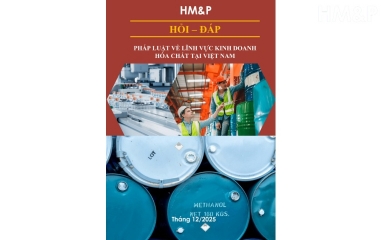
In the context that chemical business activities play an increasingly important role in many industries in Vietnam and are governed by a complex system of specialized legal regulations that are regularly updated, grasping and complying with legal requirements is a key issue for businesses. Stemming from practical needs and common problems in the process of advising clients, HM&P Law Firm ("HM&P") has compiled and developed the publication "Q&A: Law on Chemical trading in Vietnam" to clarify the current legal regulations on chemical trading. on the basis of the Law on Chemicals 2025 and the Draft Decrees guiding the implementation are expected to be issued, thereby supporting businesses to systematically approach regulations and limit legal risks in the process of operation.
In the digital economy, it can be said that personal data is and will become the operational pillar of businesses. From financial transactions, customer care, recruitment, marketing to consumer behavior analysis, every activity relies on this data stream.
Project transfer associated with land use rights (LUR) is a form in which an investor transfers all or part of an investment project to another investor, including land and attached assets. For businesses and investors, this method helps save time and take advantage of available planning and infrastructure. However, the transfer of projects associated with land use rights is a complex legal field, many regulations on investment and land must be complied with, so it is easy to arise legal risks if not careful. In this article, we will analyze legal regulations, point out some core legal issues and lessons learned for stakeholders, through the case 43/2023/KDTM-PT of the High Court in Ho Chi Minh City on May 23, 2023 on the transfer dispute of the cashew oil factory project in Binh Phuoc.
In the flow of Vietnam's tax policy reform to respond to the rapid movement of Vietnam's economy, Decree 320/2025/ND-CP (Decree 320) was born as an important "link" to complete the legal architecture of corporate income tax. Not only stopping at the role of guiding the implementation of the Law on Corporate Income Tax 2025, this Decree also marks an important step in tax administration activities, when replacing the old guiding frameworks such as Decree 218/2013/ND-CP and other guiding documents. Decree 320 was issued and takes effect from December 15, 2025.
Data intermediary is a type of business of products and services that help connect data subjects, data owners and users, through commercial agreements. This is a potential type of business because data is considered a high-value asset in the digital era and agencies, organizations and individuals currently have a high demand for connecting, sharing, exchanging and accessing data. However, opportunity comes with responsibility. Enterprises providing data intermediary products and services between service users and state agencies must be registered, managed and licensed.
The year 2025 will witness a period of the most exciting legislative activity in the country's history. Old regulations are adjusted and amended, legal frameworks that never existed are built to manage new problems that arise. Among the 28 laws that will take effect from January 1, 2026, we would like to take a look at and highlight the new highlights of important laws that affect the business activities of enterprises.
Below is a list of reputable law firms, researched by HM&P based on in-depth evaluation criteria on service quality, brand reputation as well as outstanding contributions to the legal industry in Vietnam in the past year from many different reputable sources. The list is randomly arranged as follows:
Vietnam is entering a critical phase in data management, with new regulations set in place to shape the future of data-related activities. In November 2024, the Data Law was approved by the 15th National Assembly and officially took effect on July 1, 2025 ("Data Law 2024"). This is the first time that Vietnam has enacted an in-depth law, laying the legal foundation for the management, security, processing and use of digital data .
In the context of Vietnam's economy becoming increasingly deeply integrated with the region and the world, the chemical business sector is playing an increasingly important role in many key industries such as manufacturing, healthcare, agriculture, energy and high technology. Along with the increasing demand for chemicals, the State of Vietnam has gradually perfected the legal framework to strictly manage the production, trading, import and export and use of chemicals, towards the goal of sustainable development, ensuring safety for people. environment and society.
The digital era that forces businesses to accelerate innovation to maintain a competitive advantage is creating a major polarization within organizations. On the one hand, sales and product development teams are under pressure to apply AI to optimize performance; The other side is the risk management teams (technical and legal teams) that strive to prevent incidents that cause loss of trust or ensure compliance with the law. This interference leads to a common but dangerous phenomenon: "Shadow AI" – the arbitrary use of AI tools by employees without the approval or supervision of the IT department .
-

-