


A business registration certificate issued in Vietnam that wants to be used abroad for a long time often has to go through many layers of certification. On the other hand, documents issued by foreign agencies that want to be accepted in Vietnam may also have to be certified in turn in the country of origin, diplomatic missions and competent agencies of the receiving country. Each layer of confirmation entails time, cost and risk of dossiers being returned just because of differences in seals, signatures or authority.
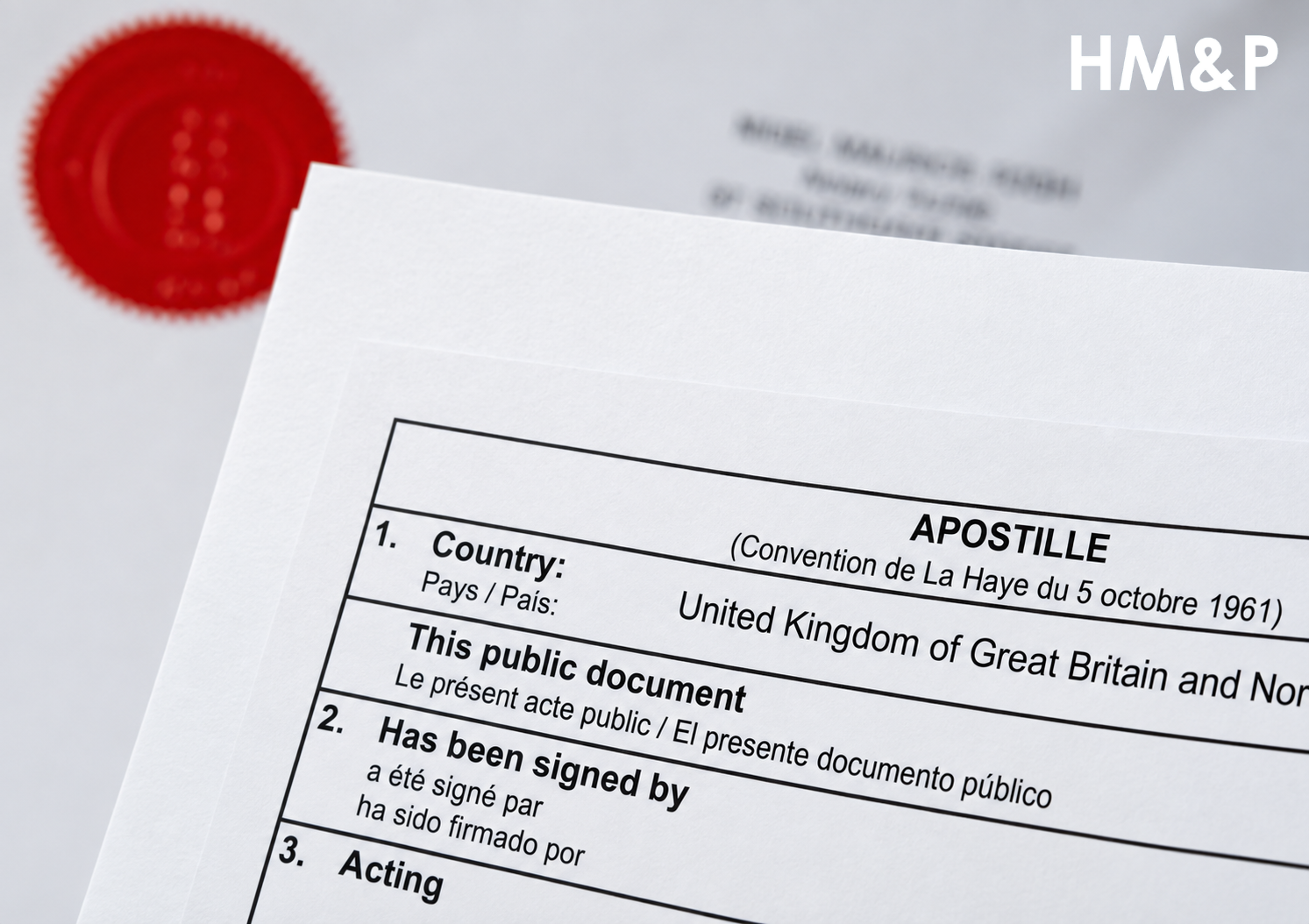
The Apostille Convention replaces that chain with a unique certificate issued in the country of origin
From today, September 11, 2026, when the Hague Convention of October 5, 1961 on the Legalization of Foreign Public Documents ("Apostille Convention")[1] comes into full force in Vietnam, this mechanism will fundamentally change the relationship between Vietnam and member states that do not oppose Vietnam's accession. The Government's Decree No. 293/2026/ND-CP dated July 23, 2026 ("Decree 293"), effective on September 11, 2026, establishes a domestic legal framework for the issuance, receipt and verification of Apostille certificates.
A certification in place of the legitimized chain
Traditional consular legalization operates based on a series of confirmations. The agency at each stage mainly confirms the signature, seal or status of the agency in front of it. This chain creates the necessary credibility, but at the same time makes people and businesses depend on many clues, how to submit documents and different processing times.
The Apostille Convention replaces that chain with a unique certificate issued in the country of origin. According to Article 4 of Decree 293, the Apostille certification confirms the origin of a public document, including the authenticity of the signature, the title and authority of the signatory, and the seal or seal on the document, if any.
Once properly granted, this certificate is recognized in the member state where the document is used without having to carry out additional consular legalization procedures.
The greatest value of an Apostille therefore lies in the elimination of repetition. Vietnam's public documents after being issued an Apostille can be used in a country that has a Convention-applying relationship with Vietnam without having to complete the entire chain of consular certification as before. On the other hand, public documents issued in a member country, after having a valid Apostille, can be submitted in Vietnam without additional steps of legalization at Vietnamese representative missions abroad.
This change takes place on a significant scale. The summary report of the Consular Department said that in 2025, there will be 1,076,393 documents consular certified or consular legalized at the Ministry of Foreign Affairs, an increase of 22.6% compared to 2024. About 60% of them have the country of origin or the country that issued the document as a member of the Apostille Convention[2].
On average, the Consular Department and the Department of Foreign Affairs of Ho Chi Minh City process about 3,200-4,300 documents per working day. These figures show that the application of Apostille is not only technically significant but can directly impact hundreds of thousands of applications per year.
From mediated confirmation to verifiable trust
Apostille does not require the receiving country to have "unconditional faith" in foreign documents. The new mechanism replaces multiple layers of confirmation with a unified information standard and an authority responsible for the issued certification.
According to the form of the Convention, the Apostille certification must show the following core information such as the issuing country; the signatory; the status of the signatory; the body with the seal; the place and date of issuance of the Apostille; the issuing authority; the registration number; the seal and signature of the person issuing the certificate.
Decree 293 also lays the foundation for electronic Apostille certification, electronic data warehouse and e-Register. When the Apostille Information System is put into operation, the QR code and online lookup interface will allow the receiving agency to check the status of the certificate. For foreign documents, agencies and organizations in Vietnam can look up the e-Register of the issuing country or request the Ministry of Foreign Affairs to assist in verification.
An electronic register cannot completely eliminate tampering, but creates a direct line of verification between the certificate presented and the data managed by the authority. Trust is therefore not only based on the appearance of the document but is reinforced by traceability and verification.
However, the digitization roadmap needs to be understood accurately. According to Article 36 of Decree 293, while the Apostille Information System has not been put into operation, the competent authority first issues a paper Apostille certificate. The issuance of e-Apostille, operation of e-Register, integration of QR codes and implementation of online procedures only start from the time the system is officially put into operation by the Ministry of Foreign Affairs.
Therefore, businesses should not automatically expect all records to be fully digitized as soon as September 11, 2026.
Substantive benefits for businesses and people
For businesses, the delay of paperwork can become the delay of the whole transaction. Documents to establish a subsidiary, change of investor, borrow capital, participate in bidding or execute an M&A deal often require a certificate of registration, resolution, power of attorney or notarized documents from multiple countries. Even one document that has not completed the authentication procedure can miss the signing schedule, extend the time to meet the prerequisites, or cause the application to be resubmitted.
Apostille helps businesses better forecast three factors: processing points, deadlines, and verifiability.
According to Decree 293, the Ministry of Foreign Affairs is the competent authority to issue Apostille certificates of Vietnam. The Ministry of Foreign Affairs can delegate this authority to provincial-level People's Committees according to specific criteria, conditions and roadmaps.
For valid paper dossiers, the processing time limit is determined according to the number of papers:
- One working day for dossiers with 1 to 4 papers;
- two working days for dossiers with 5 to 9 papers;
- four working days for dossiers with 10 or more papers.
When the full online procedure is implemented, the deadline is also shortened. Records with 1 to 4 papers can be processed in a working day; applications with 5 to 9 papers are processed in one day; applications with 10 or more papers are processed in three working days. The verification time, if incurred, is not included in these deadlines.
For citizens, the benefits of the Apostille are present in many needs with international elements: the use of birth certificates to register for study; diplomas for work; criminal record cards for settlement; marriage certificates or court decisions to settle family and property relations. The reduction of travel routes means a reduction in service costs, delivery fees, waiting times and the risk of losing original documents.
At the state level, the new mechanism also reduces the pressure on processing documents at diplomatic missions and facilitates the allocation of resources for cases that really need verification. As the usual process is standardized and gradually digitized, authorities can focus more on anti-counterfeiting, signature and seal data management, and international coordination.
Apostille confirms the origin, does not guarantee the content
The convenience of the Apostille easily leads to a dangerous misconception: the Apostille is of course correct and must be accepted for all purposes.
Article 4 of Decree 293 confirms the opposite: the Apostille certificate does not confirm the content and form of official documents.
For example, if the Apostille is attached to a notarized document, this certificate confirms the signature, the notary's status and the associated seal. It does not guarantee that every statement in the document is accurate or that the transactions underneath are automatically valid under the laws of Vietnam.
The receiving agency still has the right to consider the purpose of use, the value of evidence, the validity, duration and conformity of the content of the document with specialized law. A business registration certificate with an Apostille can prove the official origin of the document, but it does not in itself prove that the presenter still has full representation authority at the time of the transaction.
An Apostille also does not automatically replace the translation, notarization or authentication required by procedures in the receiving country. A document in a foreign language, even if an Apostille has been issued, may still need a notarized or authenticated Vietnamese translation before being submitted to the competent authority in Vietnam.
This is a very important limit. Apostille helps documents overcome the barrier of origin and formal authentication, but does not evaluate the legal value of the document's content on behalf of the receiving agency.
Not every document and every country is part of the new mechanism
The Apostille mechanism is only applicable when the conditions of country, type of document and relationship of validity are simultaneously met.
First of all, both the country of origin and the receiving country must be members of the Convention, and at the same time, the Convention must take effect in the relations between the two countries. If a country objects to Vietnam's accession, or Vietnam objects to its accession under the mechanism of the Convention, the papers circulating between the two countries must still undergo consular certification and legalization.
Therefore, the fact that a country is on the list of parties to the Convention is not enough to conclude that the Apostille is definitely applied in relations with Vietnam. Users of documents need to check the list of countries that have a relationship with Vietnam published by the Ministry of Foreign Affairs.
Secondly, the core object of the Apostille mechanism is "public papers". According to Decree 293, this group includes:
- Papers made by courts, judicial agencies or competent persons in legal proceedings and judgment enforcement;
- administrative papers such as civil status papers, nationality, criminal records, diplomas, certificates, health examination certificates;
- notarized documents;
- authenticated documents, including authenticated copies, translations, signatures, contracts, or transactions;
- other papers made, issued or certified by competent agencies, organizations or persons while performing public functions.
Private documents signed by the parties do not automatically become public documents. In many cases, signatures, copies or translations must be notarized or authenticated before the document can be applied for an Apostille.
Thirdly, the Convention excludes papers prepared or issued by diplomatic or consular officials and some administrative papers directly related to commercial or customs activities. Decree 293 still reserves the ability to apply to commercial and customs documents that were subject to consular certification before the Convention came into force, according to the specific list announced by the Ministry of Foreign Affairs.
Finally, papers that have been issued an Apostille can still be refused if the certificate is forged or erased; not issued by a competent authority; not attached to public documents; does not have mandatory contents; or has been revoked or canceled. The refusal in these cases is intended to protect the integrity of the Apostille mechanism, not to restore another round of consular legalization.

Ho Chi Minh City Department of External Relations. Source: Department of External Relations.
What do businesses need to prepare?
Before each transaction, enterprises need to accurately identify the country of origin, the country using the papers and check the relationship between that country and Vietnam. This check is especially important in the early stages of implementation, when the habits of processing documents of agencies and partners may not be completely consistent.
Next, enterprises need to classify documents: (i) Public documents that can be applied for an Apostille; (ii) private documents that may have to be notarized or authenticated first; (iii) Documents outside the scope of the Convention must still be implemented according to the consular mechanism or specialized laws.
The requests of the receiving agency for originals, copies, translations, deadlines of documents and the form of submission must also be checked separately. Apostille only deals with the request for authentication of origin, without losing other conditions of administrative procedures or transactions.
For transactions with a tight completion schedule, the parties should include the issuance of an Apostille in the list of prerequisites, clearly stipulating the party responsible for implementation, the time of handover, the paper or electronic format, and the handling plan if the documents must be verified.
Power of attorney forms, lists of legal documents and instructions for overseas parent companies also need to be updated. Otherwise, businesses may continue to request consular legalization according to old habits, wasting time and costs; or vice versa, implicitly assuming that Apostille applies to all cases and preparing a lack of documents.
The turning point lies in the way beliefs are organized
In international transactions, the document does not only carry information. It must also carry the possibility of being trusted by another legal system. Consular legalization solves this problem with a chain of confirmation. Apostille deals with a common standard, a certificate at source, and a cross-border verification mechanism.
Therefore, the significance of an Apostille should not be measured only by the number of stamps or procedures cut. The real turning point is the shift from trust created through multiple layers of intermediaries to trust that is standardized, traceable and verifiable. When operated consistently, this mechanism will shorten the administrative distance between Vietnam and its partners, reducing friction for investment, trade, learning and international civil life. However, convenience is only sustainable when the user correctly understands the limits of the certification: the Apostille paves the way for the document to cross the border, but does not decide on behalf of the receiving authority the legal validity of the content contained in the document.
[1] https://treaties.un.org/doc/Publication/UNTS/Volume%20527/volume-527-I-7625-English.pdf, truy cập ngày 10/09/2026.


