


ESOP (Employee Stock Ownership Plan) is an acronym for the issuance of shares under an employee stock option program in a company. The main purpose of ESOP is to improve employee performance by changing their mindset of them, so that each employee works as an owner of the company. However, the issuance of ESOP requires the company to comply with strict legal regulations regarding the issuance of shares. In this article, HM&P will provide key points for public companies, regarding the issuance of ESOP.
The issuance of ESOP for public companies is regulated by Decree 155/2020/ND-CP dated December 31, 2020, elaboration of some articles of the Law on Securities ("Decree 155/2020/ND-CP").
1. General key points of conditions for issuing ESOP
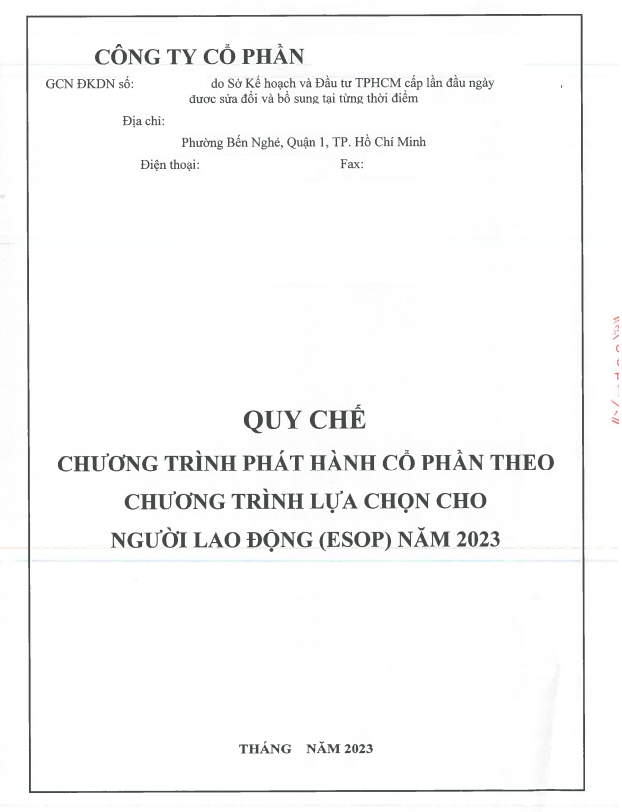
Initially, it should be noted that the issuance of ESOP by a public company includes both the case of issuing shares to employees at preferential prices and the case of issuing reward shares to employees.
Currently, the issuance of ESOP by a public company must meet the following conditions:
- The issuance plan of ESOP must be approved by the general meeting of shareholders;
- The total shares in any 12 months does not exceed 5% of the outstanding shares of the company.
- There are criteria and list of employees eligible for ESOP, rules for determining the quantity of shares to be delivered to each employee and execution time that are approved by the general meeting of shareholders. It is approved by the general meeting of shareholders or the board of directors if authorized by the general meeting of shareholders;
- For the issuance of ESOP as reward shares for employees, the equity used for the issuance of ESOP shall be determined according to the latest financial statement which is audited by an accredited auditing organization, including the following sources: surplus share capital, development investment fund; undistributed after-tax profit; other funds (if any) used for increasing the charter capital as prescribed by law;
- If a public company which is the parent company issues shares to reward employees from surplus share capital, development investment fund, other fund, the equity is based on the financial statements of the parent company
- If a public company that is the parent company issues shares to reward employees from undistributed post-tax profit, the profit used to issue ESOP must not exceed the undistributed after-tax profit according to the audited consolidated financial statements. If the profit used for issuing ESOP is less than the undistributed after-tax profit in the consolidated financial statement and more than the undistributed after-tax profit in the parent company's financial statement, the profit shall be distributed only after the profit is transferred from the subsidiaries to the parent company;
- When issuing ESOP as reward shares to employees, the total value of equity shall not be less than the total increase of share capital under the plan approved by the shareholders' meeting;
- If the company issues ESOP to employees at preferential prices for employees, it must open an escrow account to receive payment from employees for the shares;
- The issuance will comply with the foreign ownership ratio rules if shares are issued to employees who are foreign investors;
- Shares are restricted from transfer for at least 01 year from the closing date of the offering;
- A public company must obtain the approval of the State Bank of Vietnam on the application to increase the charter capital in accordance with the provisions of the Law on Credit Institutions if the issuer is a credit institution; or the approval of the Ministry of Finance on the application to increase the charter capital in accordance with the provisions of the Law on Insurance Business if the issuer is an insurer.
2. Key considerations for developing criteria and list of employees eligible for ESOP

Typically, the issuance of ESOP will be based on the contribution and number of years worked by the employees in the company. However, the current laws do not contain any specific provisions on this condition, so the company can develop its own standards and list of employees to participate in the ESOP according to its own criteria. However, when developing the standards and the list of employees eligible to participate in the ESOP, the company should pay attention to the regulations on foreign ownership ratio as prescribed by the laws in case the participants of the ESOP include foreign workers.
Currently, the limitation of foreign ownership ratio in public companies is specified in Article 139 of the Decree 155/2020/ND-CP, which specifically includes the following scenarios:
- Scenario 1: If the business lines of the public company are regulated by a treaty to which Vietnam is a party, the treaty applies;
- Scenario 2: If the business lines of the public company are regulated by regulations of laws that specify the foreign ownership ratio, these regulations shall apply;
- Scenario 3: If the business lines of the public company are on the negative list for market access, the regulations on foreign ownership ratio of each category shall apply. If no foreign ownership ratio limits are specified, the maximum foreign ownership ratio in the company shall be 50% of charter capital;
- Scenario 4: If the public company does not fall under any of the scenarios 1, 2, 3, there is no foreign ownership limit.
For example, a public company must review the business lines in which it operates to determine the foreign ownership limits applicable to its business lines. At the same time, the current foreign ownership of the company should be reviewed to develop standards and a list of employees eligible for the ESOP.
3. Key considerations for voting on approval of relevant dossiers
Pursuant to applicable laws, the general meeting of shareholders of a public company must approve a plan for the issuance of shares to employees, in which the issuance plan shall specify: the number of shares, the issue price or the rules for its determination (the board of directors may be authorized to determine the issue price) and the standards and list of employees eligible for the ESOP, the rules for determining the number of shares to be delivered to each employee and the execution time (may be delegated to the board of directors). Accordingly, persons with interests relevant to the issuance may not vote. In a public company, shareholders or members of the board of directors may be employees (having an employment relationship with the company), therefore, a public company should pay attention to such persons when voting at the general meeting of shareholders or the meeting of the board of directors. This is to ensure that the documents related to the issuance of ESOP are legally issued.
Read more at: Doanh nghiệp cần lưu ý điều gì khi phát hành cổ phiếu ESOP
[1] Pursuant to the applicable laws, the issuance of ESOP shares to employees only applies to public companies.


