


Tokenization of stocks, bonds, and real assets promises to change the way capital is raised, recognized, and traded property rights. Blockchain technology can allow tokens to be transferred almost instantaneously; but token transfer does not mean rights to the legally transferred underlying asset. The gap between technical efficiency and legal validity is the biggest challenge for a token-based capital market.

The sandbox can verify the operating model, but it does not automatically amend the rules for establishing rights in specialized laws.
1. What does the Sandbox open up and what hasn't been solved?
According to the contents of the draft published during the development of the Law amending and supplementing a number of articles of the Securities Law ("Draft"),[1] Article 6a proposes a controlled testing mechanism (sandbox) for new technologies, products, services and business models that have not been regulated by law or other current regulations. Testing is limited in scope, subjects, space and time; participating organizations must meet the conditions for approval and supervision. The Government is assigned to provide detailed regulations for these regulations.
It can be seen that this mechanism has three basic limitations.
Firstly, Article 6a establishes a general testing framework in the field of securities, not a universal license to issue stocks or bonds in the form of tokens. Whether a particular model is included or not is subject to the conditions and scope approved by the competent authority.
Secondly, the time of implementation depends on the final document approved and guided for implementation. The plan announced during the development of the Draft is expected to stipulate that the sandbox regulations will take effect from March 1, 2028.
Third, allowing technology testing does not implicitly recognize blockchain records as the basis for establishing or transferring securities ownership. The applicable authority is different from the current regulations, the responsibilities of the testing organization, and how to handle conflicts between the token record and the legal book must be specifically defined. The sandbox can verify the operating model, but it does not automatically amend the rules for establishing rights in specialized laws.
2. What rights do tokens represent?
Tokenization is the representation of assets or related rights in a unit of data recorded on a distributed ledger. This is a method of expressing and operating transactions, not a new type of ownership formed by technology alone. To determine the legal consequences, it is possible to distinguish three analytical structures, not three types of tokens officially identified by Vietnamese law.
One is a token directly associated with legal rights: the recognition or transfer of tokens is expected to establish and transfer rights to assets. This structure only comes into effect if the law governing the underlying asset recognizes the corresponding way of recognition and transfer. The second is that the token is a reference: the right is still recorded in the shareholder register, depository system, or land records; the token only reflects the data. The third is the token of economic interest: the holder has the right to request payment, division of revenue or profit according to the contract, but does not automatically own the underlying asset.
The Law on Digital Technology Industry 2025 and the Government's Resolution 05/2025/NQ-CP on the pilot implementation of the digital asset market in Vietnam have set the boundary between securities and digital assets within the scope of corresponding regulation. Putting stocks and bonds on the blockchain does not automatically transfer them to the framework of digital assets; on the contrary, tokens that only provide economic benefits are not automatically outside the securities law or regulations on capital mobilization.
3. Three groups of assets and legal bottlenecks
3.1. Stocks and bonds: challenges of two systems of recognition
The Enterprise Law allows stocks and shareholder registers to be expressed in the form of electronic data. However, the recipient of the transfer of shares becomes a shareholder when their information is fully recorded in the register of shareholders according to regulations. For a non-public joint stock company, blockchain can be the technical infrastructure for managing the ledger if the company itself maintains that system as a valid ledger, meets the requirements for content, updates, authentication and correction. Transferring tokens on an independent platform does not automatically create shareholder status.
For securities subject to centralized registration and depository, the system of the Vietnam Securities Depository and Clearing Corporation (VSDC) plays an important legal role. The problem is not to copy data to the blockchain, but to determine the time to complete the transfer and ensure reconciliation between systems. If the tokens have been transferred but the depository book has not been updated, who has the right to vote, receive dividends, principal and interest? Who is responsible when the transaction is wrong, the cryptographic key is lost, or the system stops working?
For individual corporate bonds, it is also necessary to consider the issuance conditions, investors and the mechanism of registration, depository and specialized transactions. A tokenization model cannot be used to circumvent restrictions on offering or organize the trading market outside the permitted framework. Therefore, "two books" are not just a matter of data: it is a potential conflict on the basis for identifying the owner, the timing of the transfer, and the liability for compensation.
3.2. Real assets: the right to benefit from different ownership rights
For real estate, the establishment and transfer of rights are still subject to the requirements of contract form, registration, and update of changes in accordance with relevant laws. The transfer of a token does not automatically replace the procedure for transferring land use rights or house ownership. Even if the asset is divided into multiple tokens, the technical subdivision does not give rise to a new joint ownership mechanism outside of the current law.
One structure that is often studied is the specialized legal entity (SPV) in the name of the asset, while the token represents a contractual right or interest from the equity in the SPV. However, the SPV does not create an investor protection mechanism on its own: it must see who has the right to sell, mortgage, or replace the asset, whether the cash flow is segregated, and how much the token holder has the right to monitor and prevent conflicts of interest.
If the token only creates the right to demand payment for the SPV, the investor may be in the position of an unsecured creditor when the legal entity becomes insolvent. If the token is tied to a stake or equity, their rights must be considered in accordance with the corresponding corporate mode and transfer limitations. Legal due diligence must therefore begin with enforcement rights, collateral, and payment order, rather than just from a description of expected returns.
3.3. Right to request and receivables: easy to digitize but difficult to verify
The Civil Code allows the transfer of the right to request in principle without the consent of the obligor, unless otherwise agreed or stipulated. The transferor must notify in writing, unless otherwise agreed; Article 369 also stipulates the right of the obligor to request proof of the transfer. Therefore, blockchain does not replace checking transfer restrictions, notifying and proving creditor status.
The risk is not only at the notification stage. Does the receivable actually exist, are due, are in dispute, pledged, or have been transferred to another party? Does the obligor have the right to deduct or cite any objections? An immutable record proves a data that has been recorded, does not prove a legitimate underlying transaction. The tokenization platform needs a process of due diligence, confirmation of receivables, and processing of duplicate transfers.
Not all receivables are factoring under banking laws. However, if the model is essentially a managed credit or financial services provision, the implementing entity may have to meet specialized conditions. Boundaries must be assessed from contracts, cash flows, the role of the platform, and the risk allocation mechanism, not just the name "tokenization".
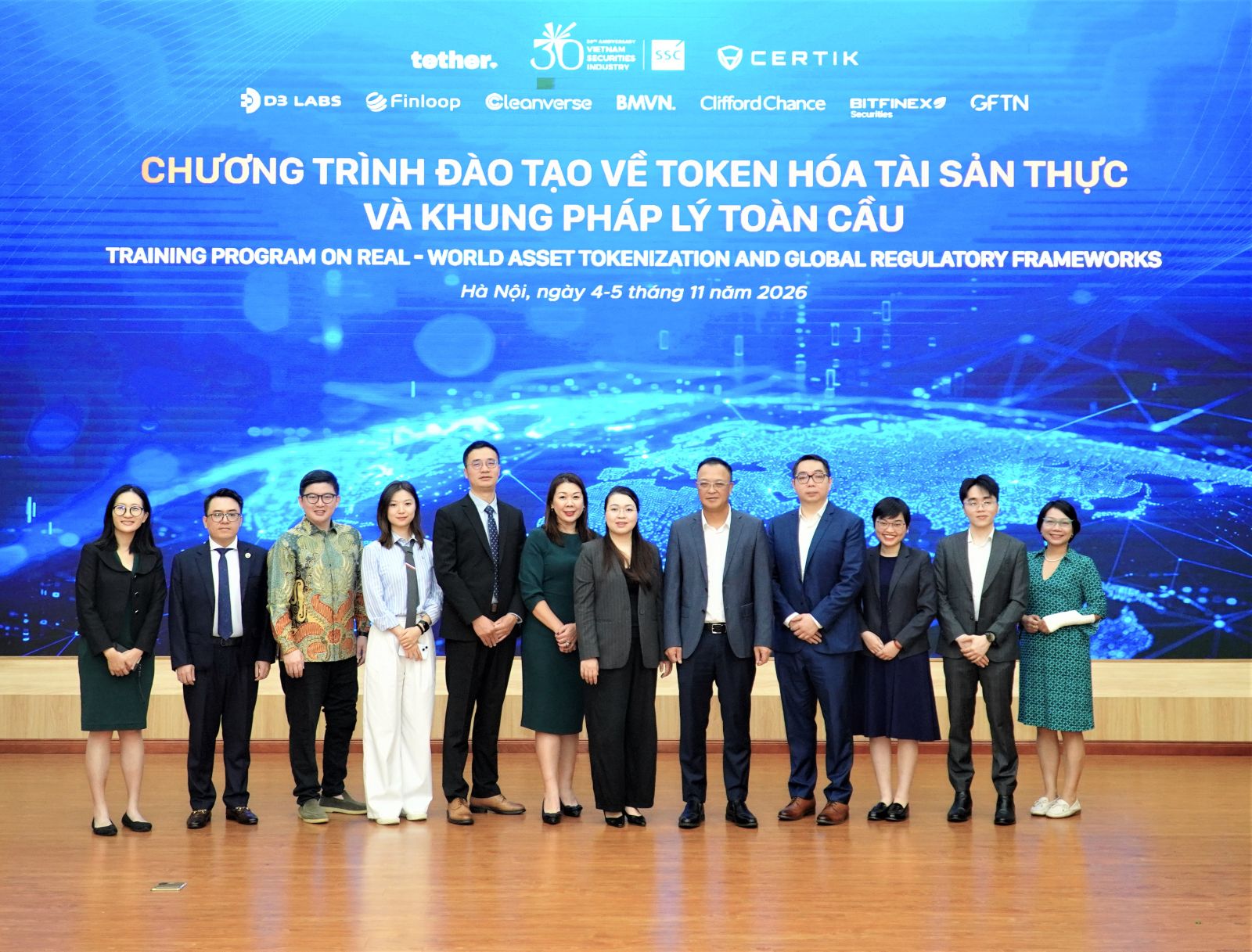
The State Securities Commission of Vietnam (SSC) organizes a training program on real-world asset tokenization. Source: SSC
4. How solvable is the Sandbox?
A valuable sandbox must simultaneously test the technological efficacy and legal certainty: the ability to reconcile with the legal ledger, the time of completion of the transaction, the error rate, the data recovery plan, the safety of custody and the cost of compliance. It is necessary to clearly identify the person responsible for the loss of the cryptographic key, the wrong recording or the payment problem.
Equally important is the mechanism for ending the test. When the license is revoked or the model is not officially implemented, under which book will the token be converted, settled, or continue to be recorded? Investors' rights must be preserved or handled according to a transparent plan; otherwise, a successful technical test may still fail legally.
5. Is Vietnam's capital market ready?
Vietnam already has an initial basis for researching tokenization, but there is no unified framework for the establishment, transfer and protection of all property rights in tokens. Different levels of readiness: electronic shareholder books and transfer of rights require a certain application space; centralized depository securities and real estate require a closer connection to the registration, depository and transfer mechanisms.
Therefore, the priority question of businesses is not how quickly to issue tokens, but what rights do tokens represent, where are those rights recognized, who is obligated to perform them, and how investors are protected in the event of a dispute or bankruptcy. Technology can improve the speed and ability of transactions; but it is the legal certainty that determines whether tokenization can become a sustainable capital mobilization channel for a new phase of Vietnam's capital market.


