


Following the publication “Practical Issues in Applying Corporate Income Tax Exemption Regulations for Small and Medium-Sized Enterprises”, HM&P continues to provide updates and address a number of legal issues arising in practice in relation to the application of the three-year Corporate Income Tax exemption policy under Decree No. 20/2026/ND-CP.
In this continuation, starting from Question 7, HM&P focuses on clarifying additional specific scenarios that enterprises may encounter when determining the conditions, exemption period, and scope of application of the Corporate Income Tax incentive, thereby providing businesses with further reference for the practical implementation of this policy.
7. When established in January 2026, enterprises are defined as small and medium-sized enterprises according to Decree 80/2021/ND-CP. By December 2027, the enterprise will grow (expand its scale, increase the average number of employees paying social insurance premiums annually, increase revenue, etc.) to the point of exceeding the criteria to be considered a small and medium-sized enterprise. At this time, it is still in the period of enjoying CIT exemption for 03 years according to Decree 20/2026/ND-CP, so is that enterprise still entitled to CIT exemption incentives? How is the 03-year CIT exemption incentive calculated?
HM&P:
Nope. From the tax period, if the enterprise no longer meets the criteria for small and medium-sized enterprises, the enterprise will not be entitled to CIT exemption incentives for that tax period.
The reason is that this incentive mechanism applies on the principle of self-determination of conditions for each tax period without determining a single time, so it is not fixed for all 03 years. The Ministry of Finance has clearly confirmed this principle when responding to a similar situation on the Government Electronic Newspaper on May 12, 2026[1].
For the above situation, the CIT exemption incentive will be calculated as follows: because the enterprise still meets the conditions for small and medium-sized enterprises in the tax periods of 2026 and 2027, the enterprise is still entitled to keep the incentives enjoyed for these two years without being arrears. For the tax period of 2028, enterprises officially no longer meet the criteria for small and medium-sized enterprises, so enterprises need to pay attention to accurately determining tax incentive conditions in accordance with the actual situation of enterprises to declare and finalize taxes according to regulations.
8. What tax incentives are applied to small and medium-sized enterprises that are eligible for CIT exemption for 03 years under Decree 20/2026/ND-CP and have investment projects in difficult areas?
HM&P:
According to regulations, in case an income of a small and medium-sized enterprise is exempt from CIT according to Clause 3, Article 7 of Decree 20/2026/ND-CP, and at the same time is eligible for tax exemption or reduction under another regulation outside this regulation, the enterprise is not allowed to accumulate both policies to enjoy both incentives. Enterprises may only choose to apply the most beneficial policy and after making the selection, they must maintain stability and must not be changed during the period of enjoying the incentives, even if they later find that the other option is more beneficial[2].
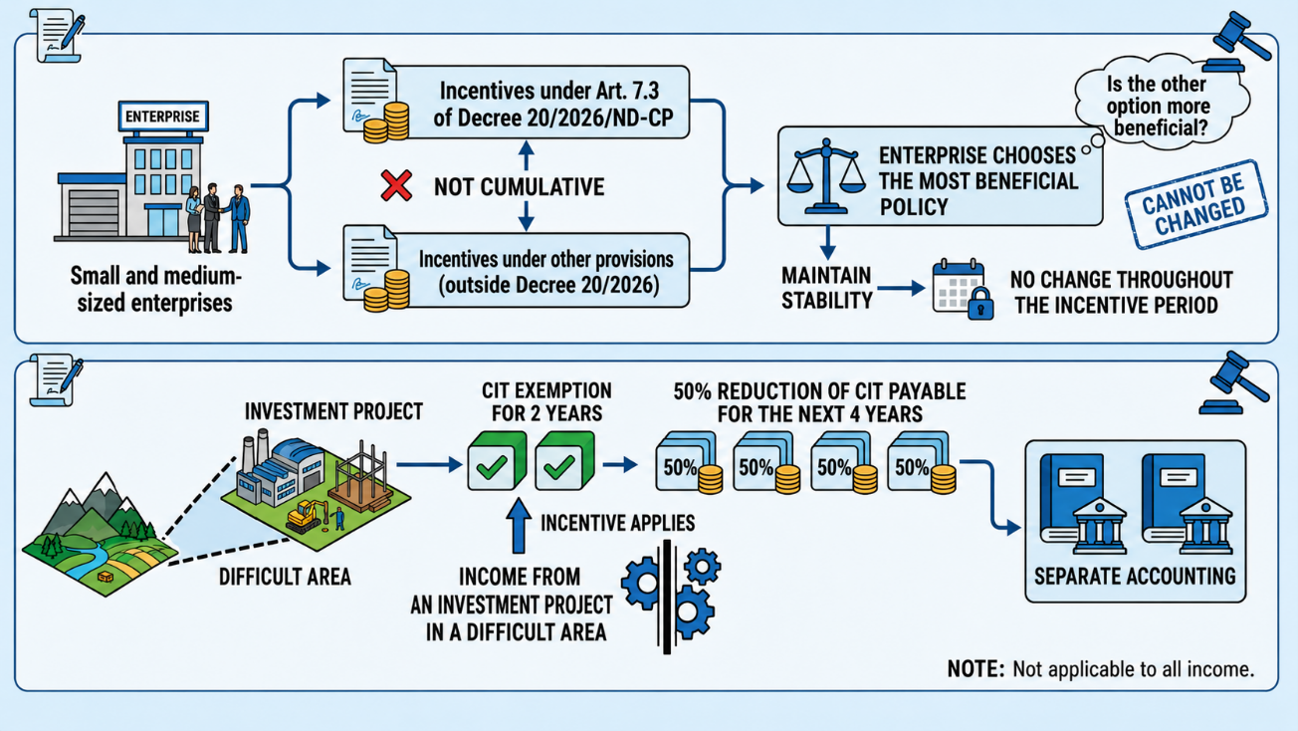
In the situation where enterprises have investment projects in difficult areas, the corresponding incentives are specified in Decree 320/2025/ND-CP, i.e. tax exemption for 02 years, reduction of 50% of the payable tax amount for the next 04 years[3]. This is a preferential level that only applies to the income from investment projects in difficult areas and must be accounted separately[4] , not to the entire taxable income.
Therefore, because the regulations allow the selection of more favorable incentives, enterprises are not bound to apply simultaneously or in a fixed direction, but have the right to actively balance and calculate based on their actual business situation and plan to choose the most suitable tax incentive policy for the business.
9. In order to enjoy the 03-year CIT exemption incentive according to Decree 20/2026/ND-CP, do enterprises have to apply for certification or pre-registration with the tax authority?
HM&P:
As a general rule, enterprises do not need to carry out procedures for certification or prior registration with the tax authority. The application mechanism is that enterprises self-determine, self-declare and take responsibility for themselves. The tax authority also does not issue a separate "tax exemption decision" to the enterprise and the check of whether the incentives are applied correctly or not only takes place during later inspections and examinations. According to Circular 20/2026/TT-BTC, enterprises themselves determine the conditions for tax exemption, tax reduction, and tax exemption period to declare and finalize taxes with tax authorities. This is also the Ministry of Finance's answer to a similar real-life situation on the Government Electronic Newspaper on May 12, 2026[5].
Here are some technical notes for businesses when determining the conditions for tax exemption, tax reduction, and tax exemption period when declaring and finalizing tax:
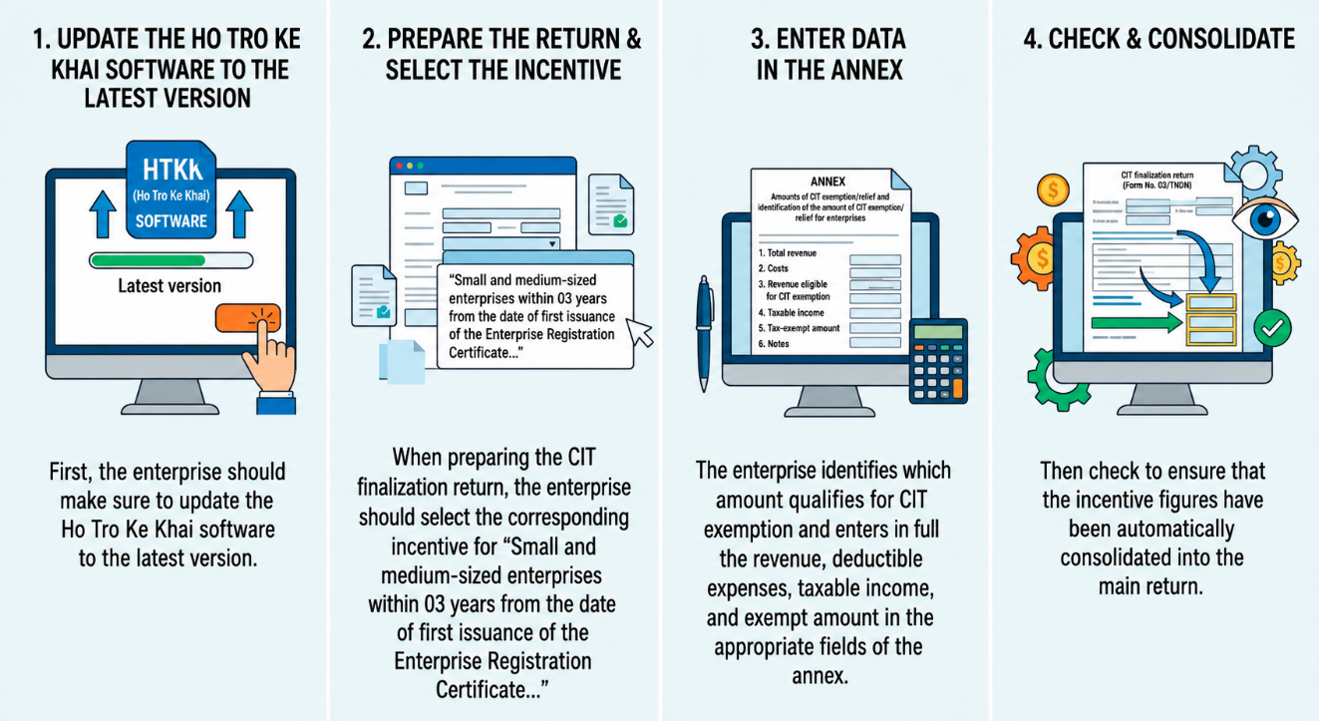
10. If a small and medium-sized enterprise is established and granted a first-time Enterprise Registration Certificate before the effective date of Resolution No. 198/2025/QH15 (May 17, 2025), will it be entitled to CIT exemption incentives under Decree 20/2026/ND-CP? How is the CIT exemption period calculated?
HM&P:
Yes. Enterprises are still entitled to CIT exemption incentives for the remaining period of 03 years, as long as at the time Resolution 198/2025/QH15 takes effect (May 17, 2025), the enterprise's operation period is still within the frame of 03 years from the date of issuance of the first Enterprise Registration Certificate.
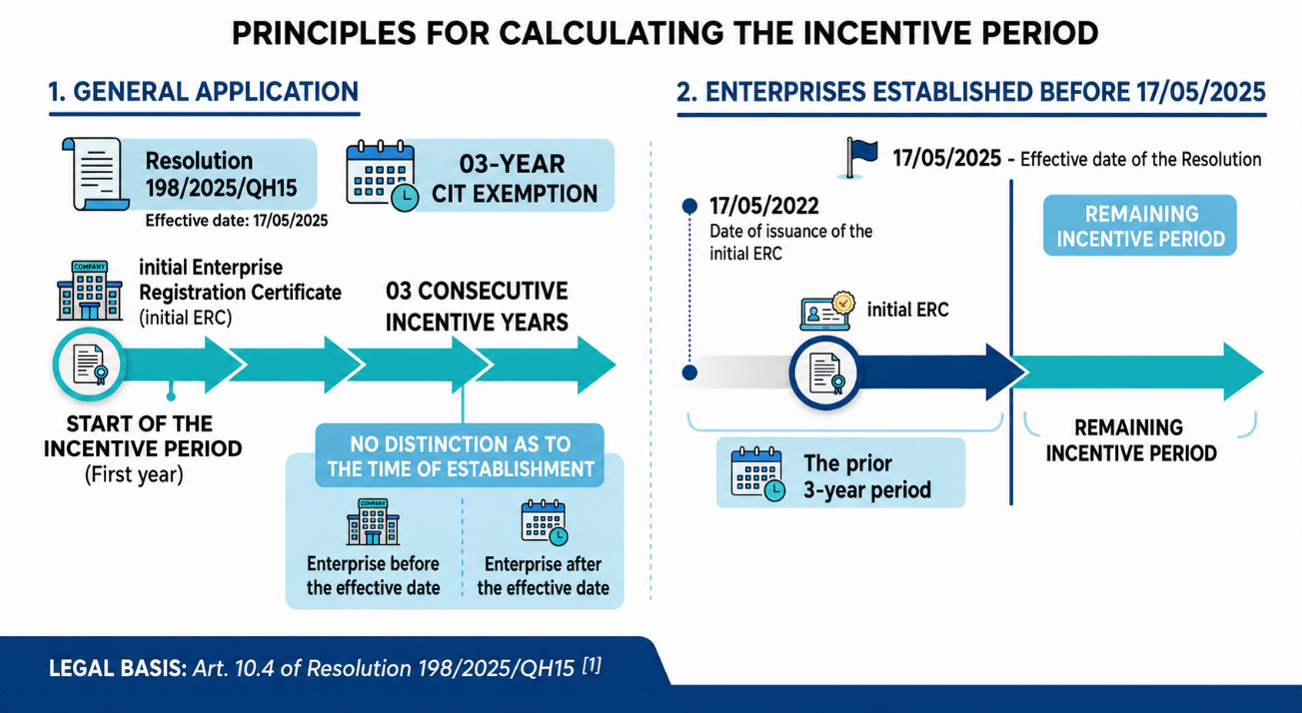
Principles for calculating the duration of enjoying incentives:
- General application: According to Resolution 198/2025/QH15, the policy of CIT exemption for 03 years is calculated continuously from the first year of being granted the Certificate of Business Registration for the first time, regardless of whether the enterprise was established before or after the effective date of the Resolution.[6]
- For enterprises established before May 17, 2025: To enjoy incentives, the time of issuance of the first Business Registration Certificate must be after May 17, 2022 (to ensure that it does not exceed the 3-year period as of May 17, 2025). Enterprises will be exempt from CIT for the remaining preferential period.
Practical application:
For example, if enterprise A is established on 20/05/2022, until 17/05/2025, enterprise A will still be exempt from CIT if it meets the conditions for small and medium-sized enterprises when calculating CIT in 2025. Because 2025 is the only remaining year within the 3-year period to enjoy the incentives of enterprise A. This is also guided in detail by the tax authorities. Specifically:
- Base tax 2 in Khanh Hoa province has been guided through Official Letter No. 4532/TCS2-QLDN2 dated April 20, 2026. Accordingly, a company registers its business for the first time on March 6, 2023, meets the criteria for small and medium-sized enterprises as prescribed[7] and does not fall into the excluded cases at Point b, Clause 3, Article 7 of Decree 20/2026/ND-CP.
- As of May 17, 2025 (the Resolution takes effect), the company has only been operating for more than 02 years. The 3-year incentive framework of this company will end in early March 2026.
- Therefore, if it meets all the criteria for small and medium-sized[8] enterprises and does not fall into the exclusions as prescribed[9], the company is still entitled to CIT exemption according to this regulation for the tax period of 2025.
11. A single-member limited liability company established on August 1, 2026, is a small and medium-sized enterprise that is exempt from CIT for the first 3 years according to Decree 20/2026/ND-CP. So can the Company choose to postpone the start of CIT exemption, that is, it will start to apply in 03 years 2027, 2028, 2029 and skip the tax period of 2026?
HM&P:
Yes. In this case, the Company can choose the CIT exemption period of 03 years 2027, 2028, 2029 and skip the tax period of 2026.
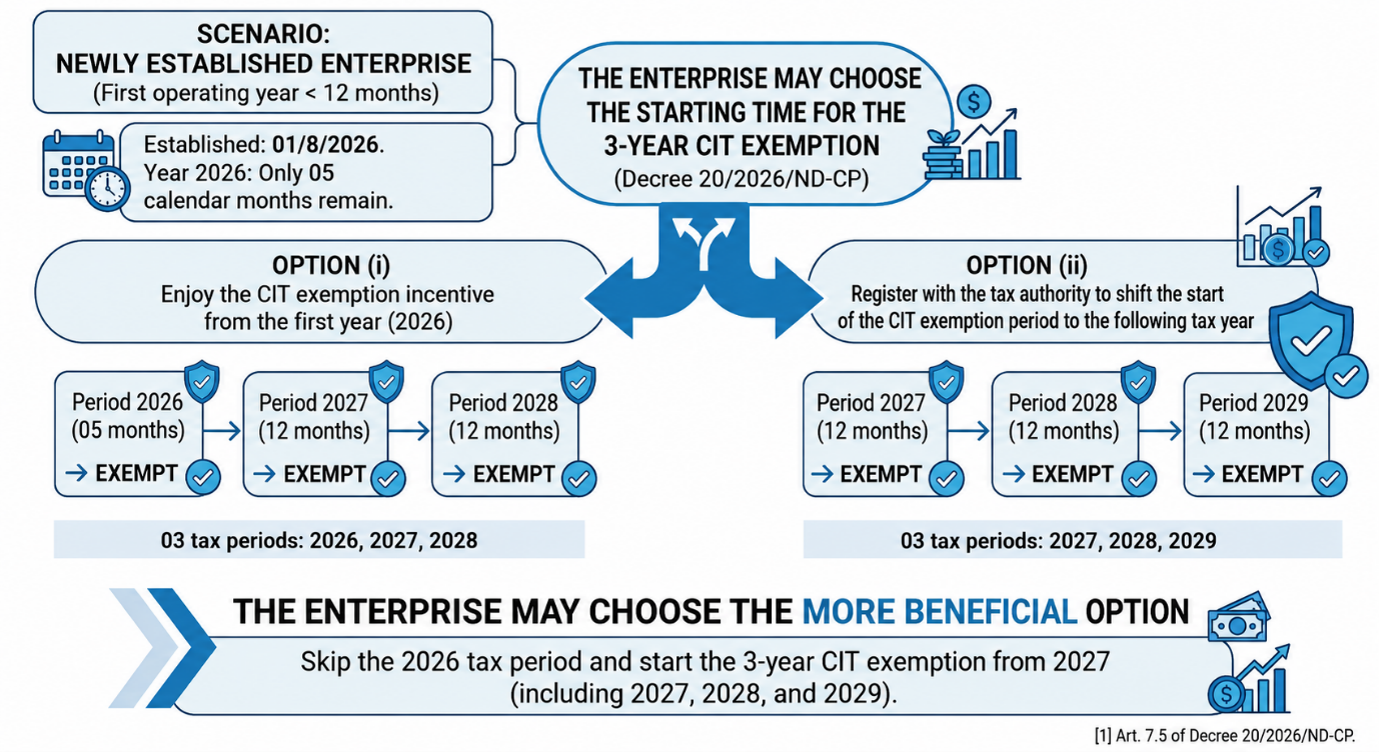
According to Decree 20/2026/ND-CP, if the first year of operation is less than 12 months, enterprises have the right to choose one of the following two options, (i) enjoy CIT exemption incentives from the first year; or (ii) register with the tax authority to postpone the start of calculating 03 years of CIT exemption to the next tax period[10].
In this case, the enterprise is established on August 1, 2026, then there are only 05 calendar months left in 2026, so at this time, the enterprise will be able to choose one of two options, (i) enjoy CIT exemption incentives from 2026 (declared in the tax period 2026); or (ii) register with the tax authority to postpone the time of calculating 03 years of CIT exemption starting from 2027.
Therefore, businesses have the right to choose a more profitable option, that is, skip the tax period of 2026 and start calculating the CIT exemption period from the tax period of the next year, including 2027, 2028, 2029.
The reason why businesses often choose option (ii) is because, during the initial investment period, most businesses are in the initial investment stage, have not stabilized revenue, and are even more likely to incur losses or very low profits. If CIT exemption starts calculating from the tax period of 2026, it is difficult for businesses to take advantage of incentives from that year because there is no or very little taxable income to be exempted. Therefore, the plan to move the time to start enjoying incentives will help businesses take advantage of this policy more thoroughly and effectively.
An important note for businesses is the regulation to use the word "registration". Practice shows that the plan to postpone the time of calculating 03 years of CIT exemption will not be automatically applied to enterprises that must register with the tax authority. If the enterprise does not take this step, the tax authority will assume that the enterprise has chosen the option to enjoy CIT exemption incentives from 2026. Therefore, to avoid the case of the tax authority defaulting to calculating incentives from 2026, businesses need to actively send a written request to the tax authority directly managing before making tax declaration for the tax period of 2026.
For example, for a company established on August 1, 2026 and chooses not to count 2026 as the first year of the CIT exemption period, the Company should actively send a registration document to the tax authority directly managing it before submitting the CIT finalization dossier in 2026. instead of waiting for the 2027 tax period.
This method of implementation is both in line with the "registration" requirement in Clause 5, Article 7 of Decree 20/2026/ND-CP, and creates clear evidence of the time and content of the enterprise's choice in case the tax authority examines the application of incentives in the future.

12. Joint Stock Company A (defined as a small and medium-sized enterprise) was established in June 2025, with a legal representative and the person with the highest amount of contributed capital. This person is also an individual in the name of registering a business household established in 2020, terminating its operation in January 2026. In this case, is Joint Stock Company A entitled to CIT exemption incentives for the first 03 years according to Decree 20/2026/ND-CP?
HM&P:
Yes, Joint Stock Company A is still entitled to CIT exemption for the first 03 years according to Decree 20/2026/ND-CP.
This Decree excludes the application of CIT exemption incentives for 03 years in case the enterprise has a legal representative (who is not a capital contributor), a general partner or a person with the highest amount of contributed capital who has participated in business activities as a legal representative. general partners or persons with the highest amount of contributed capital in operating or dissolved enterprises but less than 12 months from the time of dissolution of the old enterprise to the time of establishment of the new enterprise[11]. Considering, this clause refers to the management roles of "enterprises", not "business households". Legally, a business household is not a business.

Therefore, in case the representative of Joint Stock Company A has registered a business household in the name of the person who is not excluded, Joint Stock Company A has a basis to enjoy CIT exemption incentives as prescribed.
Please read more and download full content of publication (PDF File) here
[1] See more at: https://baochinhphu.vn/chu-ho-kinh-doanh-gop-von-dn-thanh-lap-co-duoc-mien-thue-102260512103528225.htm (accessed on 20/7/2026).
[2] Clause 4, Article 7 of Decree 20/2026/ND-CP.
[3] Clause 2, Article 20 of Decree 320/2025/ND-CP.
[4] Clause 1, Article 23 of Decree 320/2025/ND-CP.
[5] See more at: https://baochinhphu.vn/chu-ho-kinh-doanh-gop-von-dn-thanh-lap-co-duoc-mien-thue-102260512103528225.htm (accessed on 20/7/2025).
[6] Clause 4, Article 10 of Resolution 198/2025/QH15.
[7] Article 5 of Decree 80/2021/ND-CP.
[8] Article 5 of Decree 80/2021/ND-CP.
[9] Point b, Clause 3, Article 7 of Decree 20/2026/ND-CP.
[10] Clause 5, Article 7 of Decree 20/2026/ND-CP.
[11] Point b2, Clause 3, Article 7 of Decree 20/2026/ND-CP.


