


From January 1, 2026, the Law on Chemicals No. 69/2025/QH15 replaces the Law on Chemicals 2007 and establishes a new management mechanism for chemicals requiring special control. This list is divided into group 1 and group 2, with different management requirements.
For group 1 chemicals, an Import Permit is a condition for customs clearance, except for exemptions. Therefore, even a single error in the chemical name, CAS code, content, import purpose, or commercial invoice can slow down the shipment and incur compliance risks.
The safety process should start with three things: properly classifying chemicals, checking exemptions, and preparing documents consistent with the actual transaction.
The safety process should start with three things: properly classifying chemicals, checking exemptions, and preparing documents consistent with the actual transaction.
1. Why do I need an import license?
Group 1 includes many types of chemicals with a high level of risk or controlled under international treaties, including table chemicals and industrial precursors. The licensing mechanism helps the management agency control the subject, purpose, quantity and path of each export and import transaction.
According to Clause 2, Article 14 of Decree No. 26/2026/ND-CP, organizations and individuals exporting and importing chemicals requiring special control must have a license; this is a condition for customs clearance. The license is valid for 06 months from the date of issuance and can be extended once, up to 06 months, if the transaction has not been carried out or completed.
2. Identify the right chemicals and application cases
According to the Law on Chemicals 2025, chemicals subject to special control include: (i) chemicals subject to control for the implementation of international treaties on chemicals to which Vietnam is a signatory; and (ii) chemicals that are likely to cause harm to national defense, security, social safety, people, property or the environment[1].
The list and grouping are specified in Appendix III of Decree No. 24/2026/ND-CP. Enterprises must directly compare each chemical component with this list, instead of speculating according to their use or trade name.
The grouping directly determines the license exemption threshold and dossier obligations. In particular, the exemption threshold for mixtures containing group 1 chemicals is lower than that of group 2, so the classification results must be based on reliable technical data.
When reviewing, it is necessary to simultaneously compare the chemical name, CAS code, and content of each ingredient in the mixture. The same substance can have multiple trade names; conversely, a trade name can contain multiple ingredients with different management mechanisms.
3. Licensing competence belongs to provincial-level People's Committees
From 29/05/2026, the provincial-level People's Committee will receive and settle procedures for granting, re-issuing, granting, adjusting and extending licenses for export and import of chemicals requiring special control of group 1. Enterprises need to submit dossiers to local competent agencies according to the regulations on decentralization and instructions for receiving published[2] dossiers.
Checking the correct local receiving point before submission helps limit the risk of the dossier being returned and affecting the customs clearance plan.
4. Licensing documents and process
If not eligible for exemption, the enterprise shall make 01 set of dossier according to Clause 5, Article 14 of Decree No. 26/2026/ND-CP, including:
|
STT |
Profile Components |
Requirements |
|
1 |
Written request |
An application for a license is made according to Form 07a in Appendix VII of Circular No. 01/2026/TT-BCT. |
|
2 |
Commercial Invoice |
The original; if it is issued in a foreign language, it must be enclosed with an authenticated Vietnamese translation of the organization. |
|
3 |
Chemical Safety Sheet |
Chemical safety sheet of the chemical to be imported. |
|
4 |
Activity Reports |
Report on the situation of export, import, trading, use and storage of group 1 chemicals according to the issued licenses. |
|
5 |
Business License |
Chemical trading licenses require special control if imported for business purposes. Apply the transitional regulations to before 31/12/2026 if the conditions are met. |
The new application must be sent through the online public service system. Only when the system breaks down, the enterprise will submit it by post or in person. Note, before December 31, 2026, some transitional cases are exempt from presenting a license to produce or trade in chemicals requiring special control according to Clause 4, Article 30 of Decree No. 26/2026/ND-CP.
According to Point 1.2, Clause 1, Section A, Appendix I of Resolution No. 19/2026/NQ-CP, the new issuance process includes two main milestones:
- Within 03 working days from the date of receipt, if the dossier is incomplete or invalid, the licensing agency shall notify the enterprise to supplement and complete it. The additional time is not included in the time limit for settlement.
- Within 05 working days from the date of receipt of a complete and valid dossier, the competent agency shall examine and grant the License. If refusing, the licensing agency must clearly state the reason.
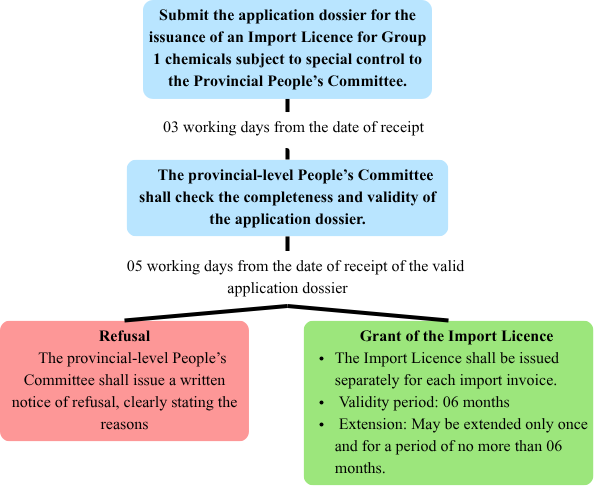
The time limit of 05 days is only counted from the time the dossier is complete and valid. Enterprises still need to reserve time to complete invoices, translations, chemical safety sheets and customs procedures. If the contents of invoices change after being licensed, enterprises must consider the procedures for adjusting the License before customs clearance.
5. Notable cases of license exemption
According to Clause 2, Article 21 of Decree No. 26/2026/ND-CP, mixtures containing group 1 chemicals with a content of less than or equal to 1% of the volume are exempt from export and import licenses. The corresponding threshold for group 2 is less than or equal to 5%.
For solvents, intermediates, or products with multiple components, businesses should ask the supplier to confirm the composition and volume ratio. It is not recommended to rely solely on product names, HS codes, or trade descriptions to conclude exemption.
Clause 6 of Article 21 also stipulates the exemption of licenses for chemicals contained in a number of products and goods that have been regulated by specialized laws, such as pharmaceuticals, food, cosmetics, pesticides, fertilizers, building materials, paints, printing inks, household products, petroleum, batteries, batteries, medical equipment and laboratory equipment. Enterprises need to determine whether the actual goods are in the specified specialized scope or not.

For group 1 chemicals, a short licensing time does not mean a simple process.
6. Three risks businesses need to control
Firstly, wrong classification. Enterprises need to compare chemical names, CAS codes, contents and mixed ingredients with Appendix III of Decree No. 24/2026/ND-CP; at the same time, check whether chemicals are on other management lists.
Secondly, the dossier does not match the transaction. The name of the goods, ingredients, contents, quantity, partners and information on the invoice, chemical safety bill, bill of lading and customs declaration need to be consistent. Changes in the content of the invoice may give rise to procedures for adjusting the License.
Third, there is a lack of tracking data. Reports on the export, import, trading, use and storage of group 1 chemicals under the issued licenses are a component of the dossier. Enterprises should update the data by each shipment instead of summarizing them when preparing the next permit application.
For group 1 chemicals, a short licensing time does not mean a simple process. The decisive point is the quality of input data: correct classification, correct identification of exemptions, preparation of uniform documents and timely monitoring of all changes of transactions. Doing these four things well helps businesses protect customs clearance progress and limit legal risks.


