


The Law on Pharmacy 2024 is considered to have helped expand the ability to develop the pharmacy chain model as a step forward in modernizing the pharmaceutical distribution system. But the burden of administrative procedures has not been eased much. The overlap in registration procedures not only reduces the efficiency of centralized management and hinders the modernization of the supply chain to bring pharmaceuticals to consumers.

The 2024 Law on Pharmacy is considered to have expanded the potential for developing pharmacy chain models, marking a significant step forward in the modernization of the pharmaceutical distribution system. Source: The Saigon Times
Many points need to be removed
According to current regulations in Decree 01/2021/ND-CP, businesses still have to register each retail establishment individually, causing fragmentation in management and increasing operating costs.
The draft decree detailing a number of articles and measures to implement the current Law on Pharmacy 2024 (Draft Decree)[1] and the draft decree replacing Decree No. 01/2021/ND-CP on business registration currently does not have any regulations allowing simplifying the order, procedures for registration of pharmacy chains. This is one of the significant legal shortcomings, making large pharmaceutical businesses afraid to expand their scale.
In that spirit, the draft decree should allow enterprises to register the operation of pharmacy chains through general dossiers, and at the same time build an interconnected electronic data system between enterprise registration agencies and pharmacy management agencies.
This mechanism not only simplifies administrative procedures, reduces costs and processing time for both businesses and authorities as a centralized monitoring mechanism. Accordingly, each business establishment in the pharmacy chain can be closely monitored without a separate licensing process as before. At that time, businesses will be able to focus on improving service quality instead of falling into cumbersome administrative procedures.
Not to mention that the electronic data system interconnected between regulatory agencies will be an effective tool to support monitoring and ensure that all facilities in the pharmacy chain comply with quality and safety standards, as stipulated in the Law on Pharmacy 2024.
Similarly, Clause 6, Article 91 of the draft decree stipulates that if the Certificate of Good Manufacturing Practice (GMP) or foreign production license does not state the validity period, it must be issued for no more than three years from the date of submission of the application. This regulation inherits from Article 98 of Decree 54/2017/ND-CP and does not take into account the peculiarities of the licensing system in many countries.
For instance, the U.S. Food and Drug Administration (FDA) typically conducts periodic GMP inspections and typically certifies the validity of a GMP certificate for export purposes for about two years, depending on the results of the inspection and the compliance status of the manufacturing facility[2]. In case the manufacturing facility does not have a GMP certificate, they can be issued a Certificate of Pharmaceutical Product (CPP) with the same validity[3]. That is, while Vietnam maintains the requirement of a document validity period of three years, many foreign documents do not comply with this deadline - making it difficult for businesses, especially when having to update the dossier with the domestic authority.
In order to solve this problem harmoniously, enterprises should be allowed to prove that the production facility still maintains production GMP through the results of periodic inspections by competent authorities in Vietnam. This approach not only helps to reduce the burden of administrative procedures but also contributes to creating favorable conditions for pharmaceutical imports, while still ensuring the goal of quality management of drugs in the market.
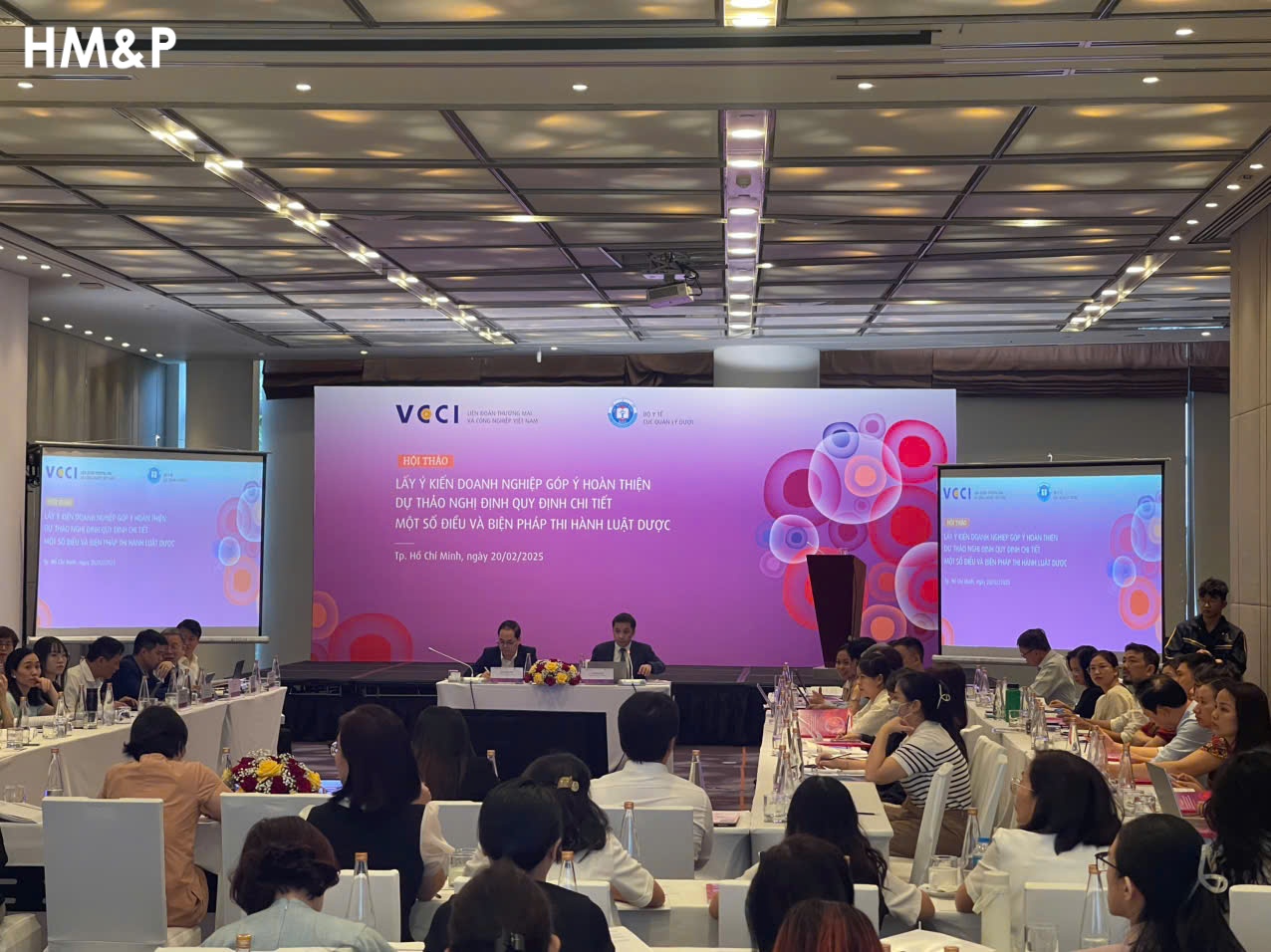 HM&P lawyer provides input at workshop on amending the Decree Guiding the 2024 Law on Pharmacy
Leaving open the management of pharmacy business on digital platforms
The strong development of e-commerce has fundamentally changed consumer behavior and the way products are distributed, including drugs and medicinal ingredients. The draft decree initially recognized this practice through Articles 45 and 46, with requirements for transparent and complete information disclosure on electronic exchanges. However, the current regulations still stop at market access conditions, have not established an effective mechanism for handling violations when online businesses do not maintain minimum legal conditions.
In addition, only requiring the posting of documents such as certificates of eligibility for business and circulation licenses without pre-inspection or post-inspection measures is creating legal loopholes. In fact, pharmaceutical e-commerce platforms are a high-risk environment if not controlled. The lack of regulations on the frequency of inspections, sanctions and mechanisms for recalling infringing products makes it possible for consumers to access low-quality drugs, directly affecting public health. In this context, it is absolutely necessary to add a periodic monitoring mechanism, require the storage of transaction data, as well as establish a quick warning system for infringing products.
The Law on Pharmacy 2024 has opened the door to new forms of business, but to ensure safety and efficiency, legal regulations need to keep up with the pace of technological development. When there is an adequate and feasible monitoring mechanism, the online pharmaceutical business is not only more tightly controlled, but also encourages innovation in the distribution model.
The draft decree needs to make important adjustments in issues such as simplifying procedures for registering pharmacy chains, flexibly applying the validity period of foreign documents and establishing a monitoring mechanism for pharmaceutical business activities on the digital platform. When these reforms are implemented synchronously, Vietnam will not only have a legal system in line with reality but also create favorable conditions for businesses to develop, improve product quality and enhance competitiveness in the international market.
Lawyer Nguyen Van Phuc - Cao Nguyen Bao Lien
Read more: Bàn về hoàn thiện khung pháp lý ngành dược
[1] https://vibonline.com.vn/su_kien/hoi-thao-gop-y-hoan-thien-du-thao-nghi-dinh-huong-dan-luat-sua-doi-bo-sung-mot-dieu-cua-luat-duoc-tp-ho-chi-minh, accessed on 2025-04-16
[2] https://www.fda.gov/inspections-compliance-enforcement-and-criminal-investigations/inspection-technical-guides/expiration-dating-and-stability-testing-human-drug-products, accessed on 16-4-2025.
[3] https://www.fda.gov/media/91749/download, accessed on 2025-04-16


